 Add to Chrome
 Add to Firefox
 Add to Edge
Towards Fine-Grained Multi-Dimensional Speech Understanding: Data Pipeline, Benchmark, and Model
May 12, 2026
While speech Large Language Models (LLMs) excel at conventional tasks like basic speech recognition, they lack fine-grained, multi-dimensional perception. This deficiency is evident in their struggle to disentangle complex features like micro-acoustic cues, acoustic scenes, and paralinguistic signals. This resulting incomplete comprehension of real-world speech fundamentally bottlenecks the development of perceptive and empathetic next-generation speech systems. At its core, this persistent perceptual limitation primarily stems from three interacting factors: scarce high-quality expressive data, absent fine-grained modeling for multi-dimensional attributes, and reliance on restricted coverage, coarse-grained benchmarks. We address these challenges through three pillars: First, our robust data curation pipeline resolves complex acoustic environments and long-audio timestamp alignment challenges to extract a high-quality spontaneous speech corpus from audiovisual sources. Second, we construct FMSU-Bench, a pioneering benchmark covering 14 speech attribute dimensions to rigorously assess the fine-grained, multi-dimensional speech understanding capabilities of current models. Third, empowered by our curated corpus, we introduce FM-Speech. Driven by a decoupled attribute modeling and progressive curriculum fine-tuning framework, it substantially elevates fine-grained, multi-dimensional acoustic perception. Extensive evaluations on FMSU-Bench reveal that current speech LLMs still require significant improvement in multi-dimensional, fine-grained understanding. In contrast, FM-Speech substantially outperforms current open-source models, establishing a robust paradigm for real-world speech understanding.

Full-Duplex Interaction in Spoken Dialogue Systems: A Comprehensive Study from the ICASSP 2026 HumDial Challenge
Apr 23, 2026Full-duplex interaction, where speakers and listeners converse simultaneously, is a key element of human communication often missing from traditional spoken dialogue systems. These systems, based on rigid turn-taking paradigms, struggle to respond naturally in dynamic conversations. The Full-Duplex Interaction Track of ICASSP 2026 Human-like Spoken Dialogue Systems Challenge (HumDial Challenge) aims to advance the evaluation of full-duplex systems by offering a framework for handling real-time interruptions, speech overlap, and dynamic turn negotiation. We introduce a comprehensive benchmark for full-duplex spoken dialogue systems, built from the HumDial Challenge. We release a high-quality dual-channel dataset of real human-recorded conversations, capturing interruptions, overlapping speech, and feedback mechanisms. This dataset forms the basis for the HumDial-FDBench benchmark, which assesses a system's ability to handle interruptions while maintaining conversational flow. Additionally, we create a public leaderboard to compare the performance of open-source and proprietary models, promoting transparent, reproducible evaluation. These resources support the development of more responsive, adaptive, and human-like dialogue systems.
CAMEL: Cross-Attention Enhanced Mixture-of-Experts and Language Bias for Code-Switching Speech Recognition
Dec 17, 2024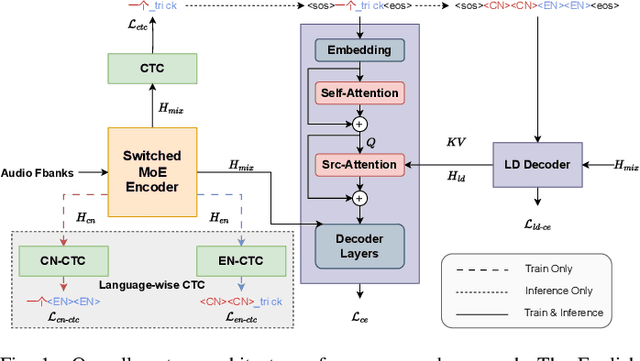
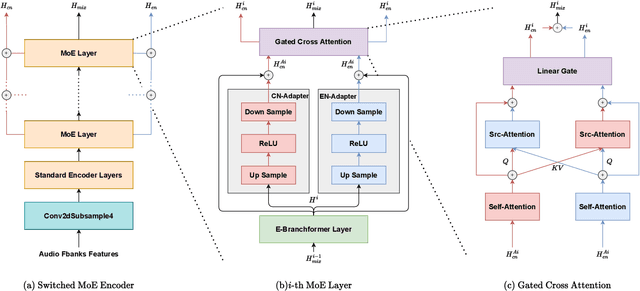
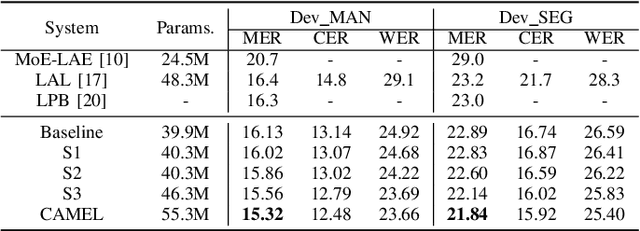
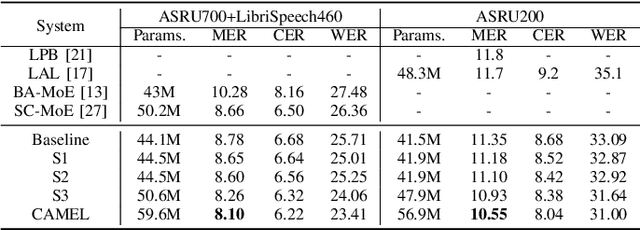
Code-switching automatic speech recognition (ASR) aims to transcribe speech that contains two or more languages accurately. To better capture language-specific speech representations and address language confusion in code-switching ASR, the mixture-of-experts (MoE) architecture and an additional language diarization (LD) decoder are commonly employed. However, most researches remain stagnant in simple operations like weighted summation or concatenation to fuse language-specific speech representations, leaving significant opportunities to explore the enhancement of integrating language bias information. In this paper, we introduce CAMEL, a cross-attention-based MoE and language bias approach for code-switching ASR. Specifically, after each MoE layer, we fuse language-specific speech representations with cross-attention, leveraging its strong contextual modeling abilities. Additionally, we design a source attention-based mechanism to incorporate the language information from the LD decoder output into text embeddings. Experimental results demonstrate that our approach achieves state-of-the-art performance on the SEAME, ASRU200, and ASRU700+LibriSpeech460 Mandarin-English code-switching ASR datasets.